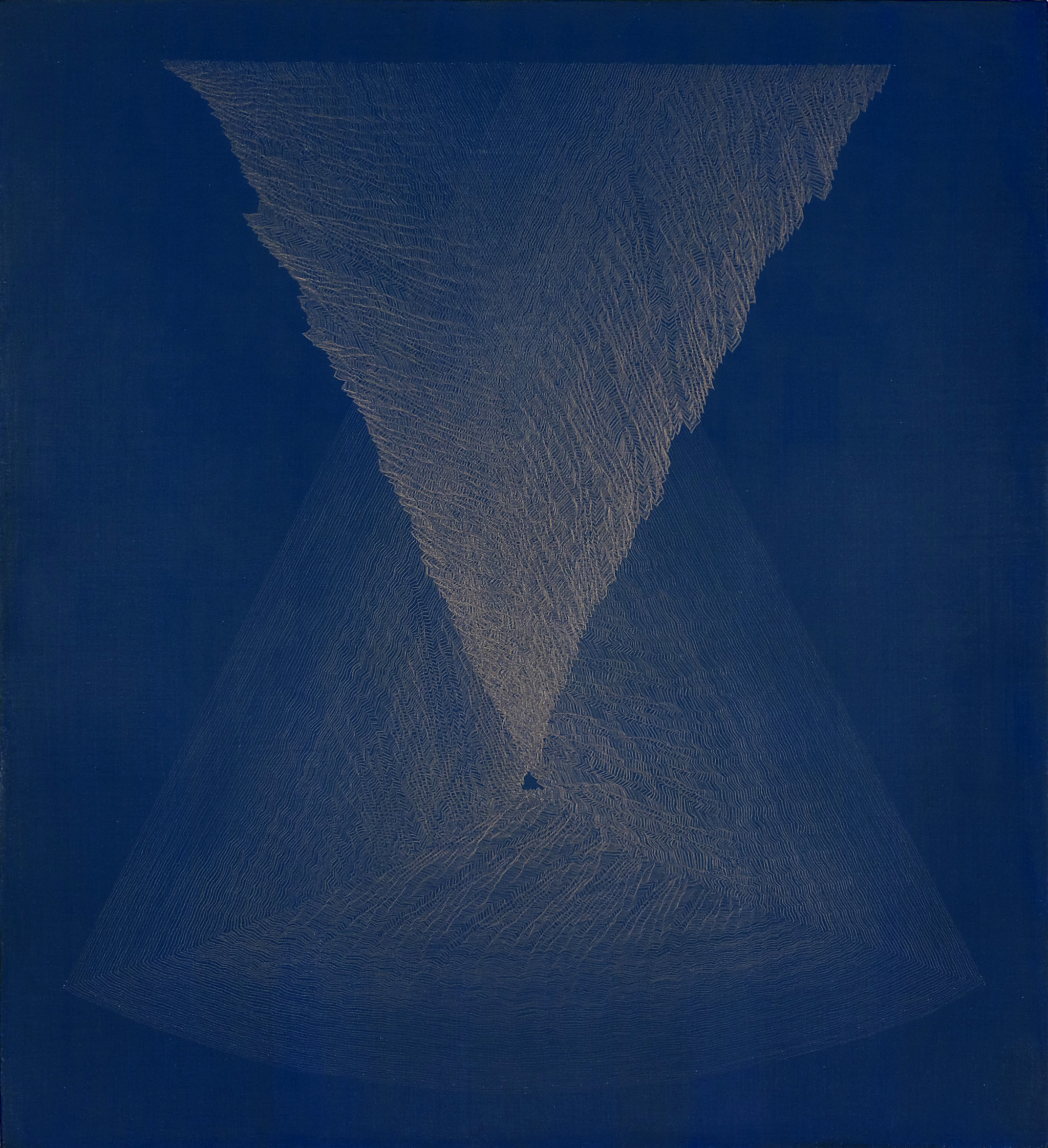
「balance (yin) /drawing for gold point, color gesso and canvas」 gold point (24k), color gesso, canvas W340 × H310 mm 2015
サンドペーパーで削って尖らせた直径2㎜の金線を、ホルダーに入れて筆記具とした金筆。この金筆で描かれた線は、最初が一番細く、徐々に太くなります。
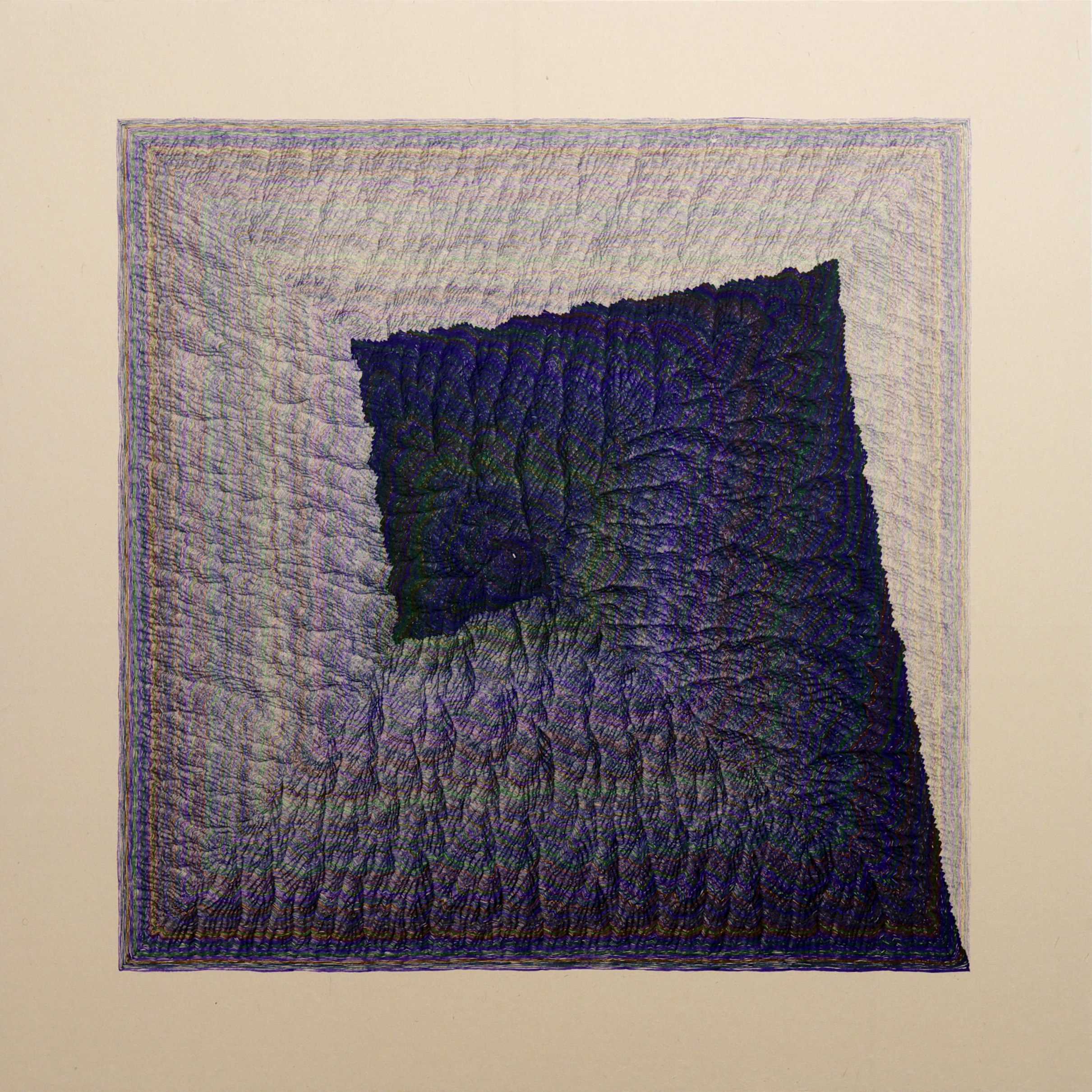 Ⅰa(yang) violet: green: orange=3:2: 1 /drawing for brush, ink and paper pigment ink, Japanese paper, brush (Raphael 8408-4) 900×900mm 9 Dec.2016 筆で描かれた線は、インクを含んだ最初が太く、徐々に細くなり、かすれて行きます。この作品では、同明度に調整された青、黄、赤という三原色の線が1:2:3の割合で構成されています。色線の順番はサイコロの出目でランダムに決められます。
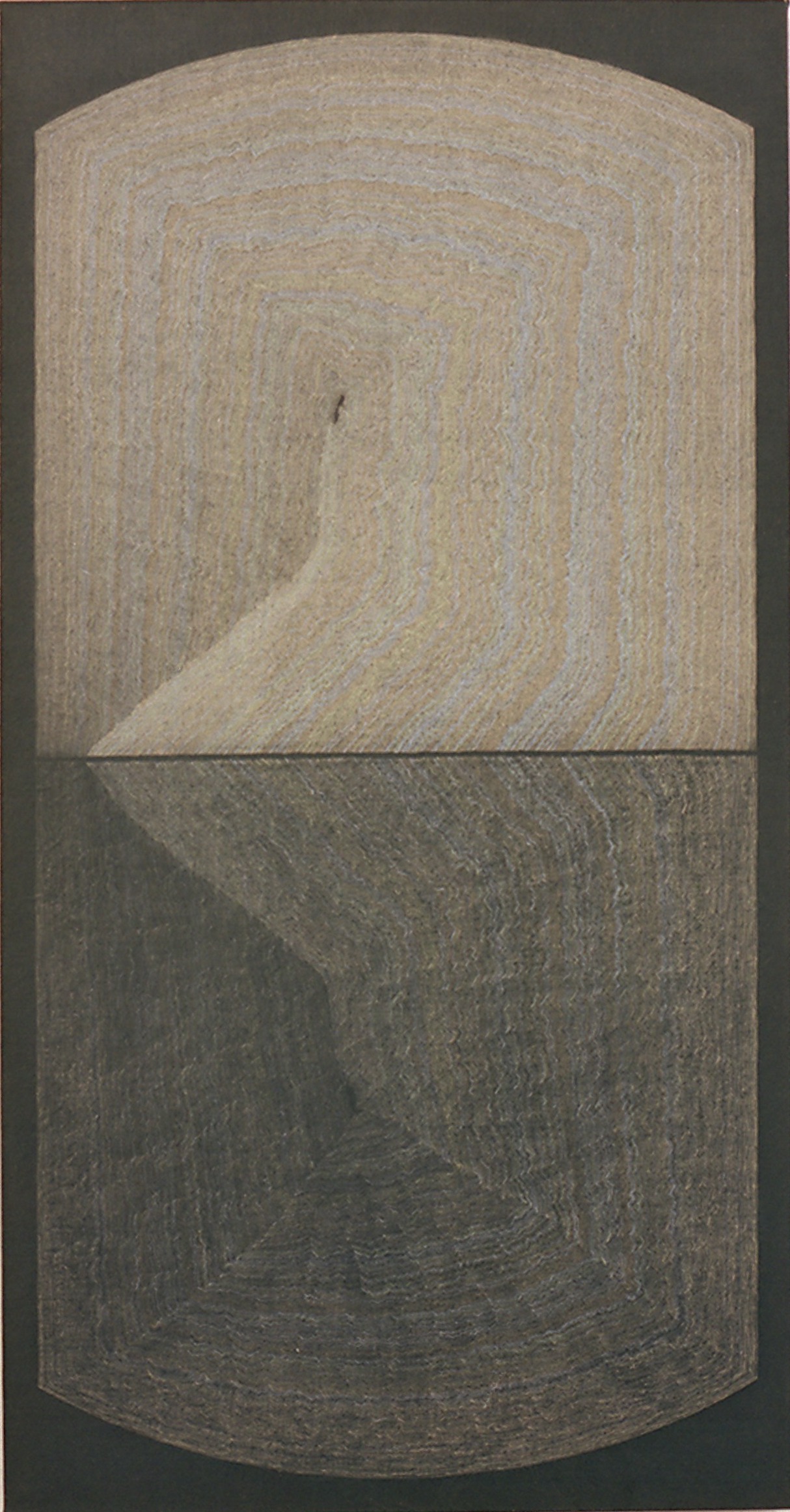 shadow(curtain) BG(yang)violet: green: orange=2:1:6 / drawing for pencil sharpener, colored pencils and canvas colored pencils, canvas, color gesso 845×440mm 27 Jan. 2010
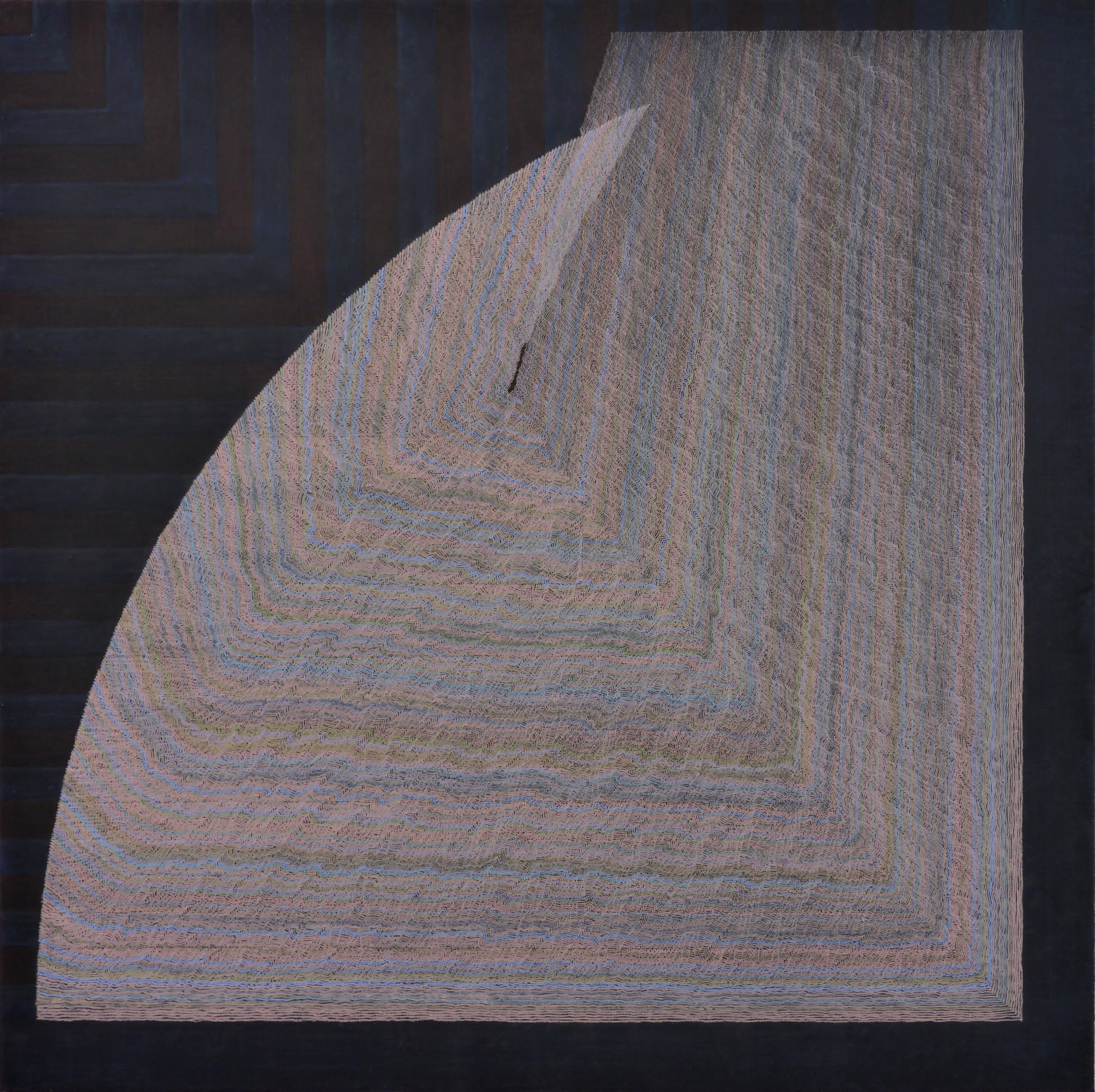 little sprout violet : green : orange =3:1:8 /drawing for pencil sharpener, colored pencils and canvas colored pencils, canvas, color gesso 600×600mm 20 Apr. 2018 Drawing for pencil sharpener, colored pencils and canva
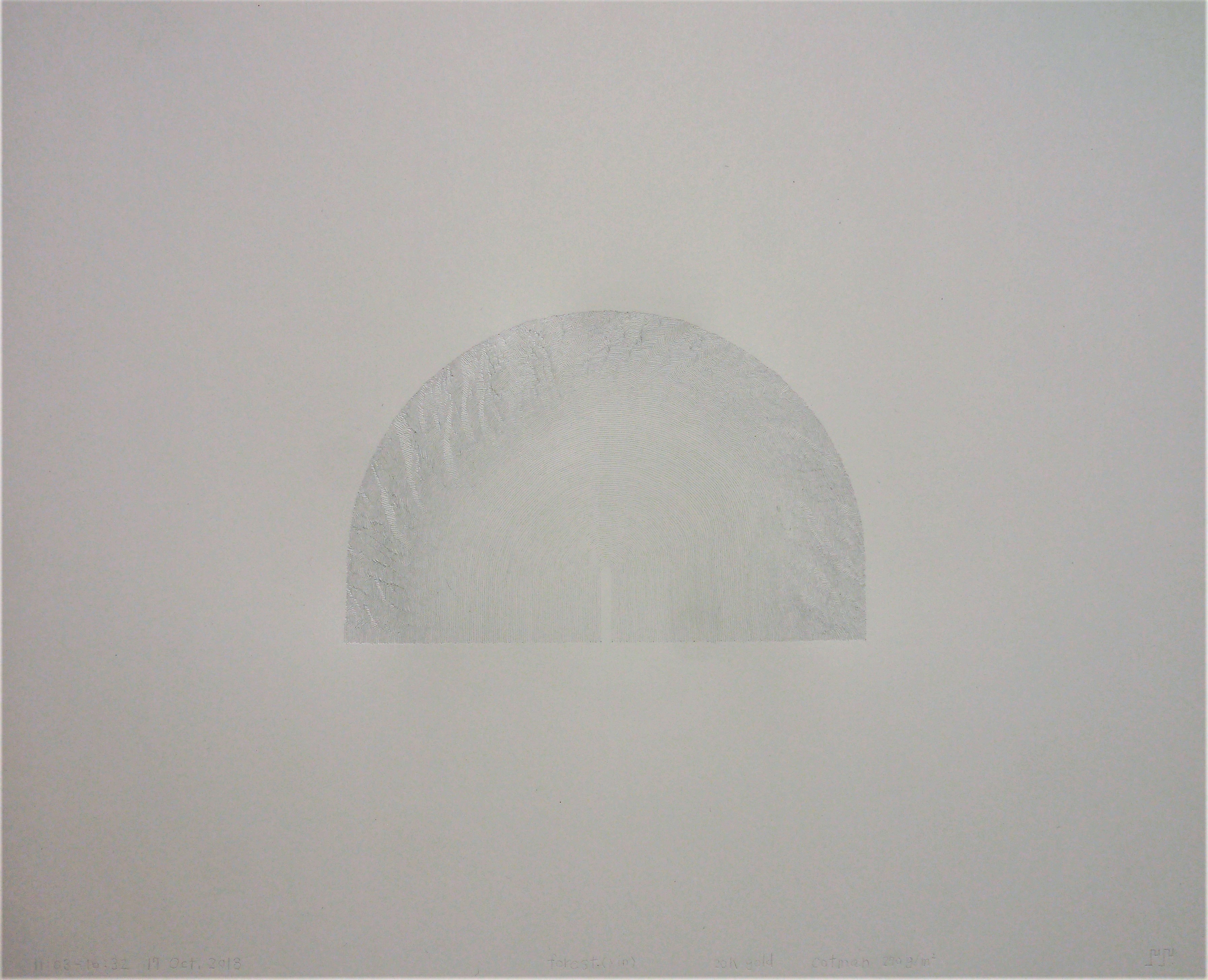 forest (yin) /drawing for gold point and paper gold point(20K), paper (Cotman 270g/㎡) 370×454 (120×192)mm 11:03-16:32 17 Oct. 2018 Drawing for metal point and paper サンドペーパーで削って尖らせた直径2㎜の銅線を、ホルダーに入れて筆記具とした銅筆。この銅筆で描かれた線は、最初が一番細く、徐々に太くなります。 銅で描かれた線は、徐々に錆びて黄色くなり、緑青が生える可能性があります。
近年、高島進の評価と人気は著しく高まり、現在もなおその勢いは止まるところを知りません。 作品はワシントン・ナショナルギャラリーやドバイのAman Residencesに収蔵され、世界のセレブリティからも注目を集めています。 その背景には、日本的な「アート」と、資産性を重視する国際的な「ART」との隔たりを越え、作品を国際的価値へと昇華させる力があります。 この評価の高まりは、単なる一作家の成功にとどまりません。 高島進の存在は、日本におけるアートの価値認識そのものを更新し、国内市場の活性化にも影響を与え始めています。 これまで軽視されがちであったアートの資産性や国際性への理解を促し、日本のアート市場の構造そのものに変化をもたらす可能性を秘めています。
ARTにおいて最も重要なのは、独創性です。 高島進の絵画は、人類が長い年月をかけて築いてきた絵画論を根底から覆します。 従来の「作家の内的イメージを具現化する」という概念を超え、素材そのものの変化を作品化する手法を確立しました。 彼の作品は、筆や鉛筆の摩耗によって生じる線の濃淡や太さの変化を、反復・蓄積することで生まれます。 その結果、画面には山の稜線のような有機的構造が立ち現れます。 それは「線の結晶体」とも呼ぶべき独自の絵画であり、一目で高島作品と認識できる強い個性を持っています。 さらに、色彩の決定をサイコロに委ねることで作家の意図を排し、偶然性を取り込む新たな絵画論を提示しました。 虫眼鏡で覗くほどの精緻な線の密度には、日本的な繊細さが極限まで引き出されています。
高島作品が持つ最大の特質は、「再現不可能性」と「視覚体験の強度」にあります。 デジタルでは代替できない物質性と、時間の蓄積によって生まれる作品は、コレクターにとって極めて高い付加価値を持ちます。 その希少性は、国際市場における評価をさらに押し上げる要因となっています。
その表現は、幼少期における線への強い執着に端を発し、半世紀にわたる制作の積み重ねによって形成されました。 また、その思想は、スティーブ・ライヒやジョン・ケージといった現代音楽のミニマリズムとも通じるものがあります。
GDPの観点から見れば、高島進の活動は文化・芸術分野における輸出力の強化を意味します。 このような作家の台頭は、日本の文化資産を国際市場へと接続し、文化GDPの拡張へとつながります。 さらに、関連産業を含めた経済全体への波及効果を生み出す契機ともなり得ます。
1959 兵庫県加古川市出身
1982 武蔵野美術大学造形学部建築学科卒業
1984 武蔵野美術学園油絵科修了
1987 アジェンデ美術学校(メキシコ)に1年留学
2026 画廊香月(東京・銀座)/ 2021, 2022, 2023
2020 ギャラリーモリタ(福岡)
2019 CHANDLER FINE ART(サンフランシスコ)/ 2012, 2014
2026 Art Future 2026 (台北/台湾) / 2024, 2025
2025 Line Traces/Life Traces | Duo Show 高島進+今西泰赳 (AIFA/ ヴェルビエーレ・スイス)
2025 ART FAIR ASIA FUKUOKA 2025(福岡)/ 2018, 2019, 2021, 2022, 2023, 2024
2025 KOBE ART MARCHE 2025(神戸)/ 2024
2025 具体・九州派からうまれたもの (京都市美術館・別館)
2024 ART KAOHSIUNG(高雄/台湾)/ 2018, 2019, 2023,
2024 ART FORMOSA (台北/台湾) 2024 ART TAICHUNG (台中/台湾) / 2021
2024 RULES FOR DRAWING+ DETAIL (DRAW SPACE/シドニー・オーストラリア)
2023 「光へ漕ぐ舟」浜口陽三と桑原弘明、高島進、前田昌良(ミュゼ浜口陽三・ヤマサコレクション/東京)
2022 ART TAINAN (台南/台湾)
2021 ART TAIPEI 2021(台北/台湾)
2021 「鏡中鏡」平松宇造、高島進雙個展(台南索卡藝術中心/台南・台湾)
2020 art TNZ(東京・品川)
2019 Infinity Japan Contemporary Art Show (台北/台湾)
2019 ART in PARK HOTEL TOKYO 2019 (東京・新橋)
2018 高島進+高木健多二人展「月と tofu と迷宮歩行」(画廊香月/東京・銀座)
2007 第5回現代日本美術会審査員特別賞
2002 第11回青木繁記念大賞公募展/優秀賞
2000 第14回多摩秀作美術展/大賞
1998 第3回アート公募99企画作家選出作品展/ギャラリー賞
1997 ABC美術コンクール/優秀賞
1997 第2回昭和シェル石油現代美術賞展/奨励賞
1990 第16回日仏現代美術展/日本テレビ奨励賞
ワシントン・ナショナルギャラリー
青梅市立美術館
羽田空港
Aman Residences, Dubai(UAE)
Amansamar (Kingdom of Saudi Arabia)
素材の強調から生まれる遠近法 →
道具と素材のためのドローイング ー →
素材がわたしに描かせている →
ジェシー・エリザベス・アルペリン →
Catherine Yen 亞洲文化協會南三三小集 執行長 →
月刊ギャラリー 2019.9 「素材がわたしに描かせている」→
月刊アートコレクターズ 「展覧会レポート」 2019より →
高島進個展-CHANDLER FINE ART- 2014 →
Off – Brussels Contemporary Art Fair 2014 Agenda Magazine →
YIA アートフェア 2015 Mahaut Le Lagadec →
VENTI journal →
梟の耳。黒猫の瞳。海馬のツブヤキ 光へ漕ぐ舟:高島進 →
「balance (yin) /drawing for gold point, color gesso and canvas」 gold point (24k), color gesso, canvas
W340 × H310 mm 2015
Lines made by a metal point are narrowest immediately after sharpening and gradually become wider.
Ⅰa(yang) violet: green: orange=3:2: 1 /drawing for brush, ink and paper pigment ink, Japanese paper, brush (Raphael 8408-4) 900×900mm 9 Dec.2016
Lines made by brushes are thickest at the beginning, and gradually become thinner and fainter. I used the colors blue, yellow and red, which are the three primary colors adjusted to the same brightness. The order of the color lines was chosen randomly by rolling dices.
shadow(curtain) BG(yang)violet: green: orange=2:1:6 / drawing for pencil sharpener, colored pencils and canvas colored pencils, canvas, color gesso
845×440mm 27 Jan. 2010
little sprout violet : green : orange =3:1:8 /drawing for pencil sharpener, colored pencils and canvas colored pencils, canvas, color gesso 600×600mm 20 Apr. 2018
Drawing for pencil sharpener, colored pencils and canva
forest (yin) /drawing for gold point and paper
gold point(20K), paper (Cotman 270g/㎡)
370×454 (120×192)mm 11:03-16:32 17 Oct. 2018
Drawing for metal point and paper
Lines made by a metal point are thinnest immediately after sharpening and gradually become thicker. Lines drawn with copper may turn to blue green.
A Singular Presence in the Global Art Market In recent years, Susumu Takashima’s market recognition has risen with remarkable attracting sustained international attention. His works are held in distinguished collections, including the National Gallery of Art in Washington, D.C., and Aman Residences in Dubai, and are increasingly sought after by a discerning global clientele.
This ascent reflects not mere popularity, but a rare capacity to translate a distinctly Japanese sensibility into a language of global “ART”—where cultural significance and asset value converge.
Takashima’s emergence signals a broader shift: a redefinition of how Japanese art is perceived, positioned, and valued within the international market.
At the highest level, artistic value is defined by originality. Takashima’s practice fundamentally departs from the traditional paradigm of painting as a vehicle for internal expression. Instead, he establishes a methodology in which the transformation of material itself becomes the work.
Through the gradual accumulation of lines—formed by the natural abrasion of pencil and brush—his compositions emerge.
These repeated gestures give rise to organic, almost topographical structures across the pictorial plane. The result is what may be described as a crystallization of lines: a wholly distinctive visual language, immediately recognizable and impossible to replicate.
Color, notably, is determined by chance through the casting of dice, removing intentional control and introducing an element of contingency. What remains is a refined equilibrium between system and accident—an expression of exceptional purity.
Central to Takashima’s work is its absolute irreproducibility. Each piece is the product of an immense accumulation of time—an attribute that resists any form of digital substitution. Its material density and optical intensity can only be experienced in the presence of the original.
This irreversibility underpins its enduring value. In an era increasingly dominated by reproducibility, such rarity assumes heightened significance within serious collections.
Takashima’s practice originates in an early fascination with line, sustained and refined over more than five decades of continuous work.
His approach resonates conceptually with the structures of minimal and process-based music, notably in the works of Steve Reich and John Cage, where repetition and duration become formative elements.
In this sense, Takashima redefines painting as a medium of time as much as of image.
Takashima’s work operates at the intersection of cultural and economic value. It not only embodies a significant strand of Japanese artistic thought, but also functions as a conduit through which cultural capital enters the global marketplace.
As such, his practice represents a critical reference point for the evolving dynamics of the international art market—where rarity, authorship, and material presence are increasingly paramount.
1959 Born in Hyogo, Japan
1982 Graduated from the Department of Architecture of Musashino Art University
1984 Completed from the Department of Oil Painting of Musashino Art School
1987-88 Studied at the Department of Fine Arts of Institute Allende, Mexico
2023 Gallery Kazuki, Tokyo
2022 Gallery Kazuki, Tokyo
2021 Gallery Kazuki, Tokyo
2020 Gallery MORYTA, Fukuoka
2019 Chandler Fine Art, San Francisco, CA
2018 Shonandai Gallery, Roppongi, Tokyo
2017 Gallery Hakudotei, Kyobashi, Tokyo
2016 Shonandai MY Gallery, Roppongi, Tokyo
2014 Chandler Fine Art, San Francisco, CA
2014 Shonandai MY Gallery, Roppongi, Tokyo
2013 Gallery Hakudotei, Kyobashi, Tokyo
2012 Chandler Fine Art, San Francisco, CA
2012 Shonandai MY Gallery, Roppongi, Tokyo
2011 Gallery Hakudotei, Kyobashi, Tokyo
2011 Motoazabu Gallery Sakudaira, Nagano
2011 Shonandai MY Gallery, Roppongi, Tokyo
2010 Gallery Beaux, Ginza, Tokyo
2010 Shonandai MY Gallery, Roppongi, Tokyo
2009 Shonandai MY Gallery, Roppongi, Tokyo
2008 Gallery Tems, Koganei, Tokyo
2025 Art Fair Asia Fukuoka
2025, Fukuoka 2025 KOBE ART MARCHE,Kobe
2024 ART KAOHSIUNG,Kaohsiung Taiwan
2024 Art Fair Asia Fukuoka 2024, Fukuoka
2024 ART FORMOSA, Taipei Taiwan
2024 ART TAICHUNG, Taichung Taiwan
2024 KOBE ART MARCHE,Kobe
2024 ART FUTURE, Taipei Taiwan
2023 ART KAOHSIUNG,Kaohsiung Taiwan
2023 Art Fair Asia Fukuoka 2023, Fukuoka
2022 ART TAINAN, Tainan Taiwan
2022 Art Fair Asia Fukuoka 2022, Fukuoka
2021 ART TAICHUNG, Taichung Taiwan
2021 ART TAIPEI 2021, Taipei Taiwan
2021 Art Fair Asia Fukuoka 2021, Fukuoka
2018 ART KAOHSIUNG 2018, / Gallery MORITA + Gallery KAZUKI, Taiwan
2018 Art Fair Asia Fukuoka 2018, Fukuoka
2018 Affordable Art Fair Hong Kong
2018, China 2017 Affordable Art Fair Brussels
2017, Belgium
Group Exhibition
2025 “What emerged from Gutai and the Kyushu-ha’ The Annex of the Kyoto City Museum of Art Kyoto 2024 DETAIL, DRAW SPACE / Sydney, Australia
2024 RULES FOR DRAWING (DRAW SPACE / Sydney, Australia)
2023 “Boats Rowing Toward the Light”: Yozo Hamaguchi and Hiroaki Kuwahara, Masayoshi Maeda, Musée Hamaguchi Yōzō Yamasa Collection,Tokyo
2021 “Mirror in Mirror”: Uzo Hiramatsu & Susumu Takashima Two-Person Exhibition,Tainan Soka Art, Tainan, Taiwan
2018 Takashima + Takaki Exhibition/ Gallery KAZUKI, Ginza, Tokyo
2017 Hideaki Yamamoto, Susumu Takashima Exhibition/ Shonandai MY Gallery, Roppongi, Tokyo
2015 YIA International Art Fair, Paris, France 2014 OFF Contemporary Art Fair, Brussels, Belgium 2012 “Encouragement of learning” at the Museum/ Ome Municipal Museum of art, Ome, Tokyo 2012 ArtPad SF (Phoenix Hotel/ San Francisco) 2011 Kito + Takashima Exhibition/ Gallery Face to Face, Kichijoji, Tokyo
2011 THE 2nd “WHAT IS DRAWING” EXHIBITION/ Galerie Simon, Ginza, Tokyo
2010 +PLUS Tokyo Contemporary Art Fair/ Tobi Art Forum, Tokyo 2010 Art Kite Show/ Gallery of Shizuoka University of Art and Culture, Hamamatsu/ Chandler Fine Art, San Francisco
2010 kun Start/ Borzano, Italy
2009 kun Start/ Borzano, Italy
2007 The 5th Contemporary Art Society of Japan (Examiner Special Prize)
2002 The 11th Memorial Exhibition of Aoki (Excellent Prize)
2000 The 14th Fine Art Exhibition in Tama (Grand Prix)
1998 The 3rd Contest for the Best Contemporary Art Work ’99 (Gallery Prize)
1997 ‘97 ABC Art Contest (Excellent Prize) The2nd Showa Shell Contemporary Art Contest (Encouragement Prize)
1990 The 16th Exposition : France-Japan (Nihon TV Encouragement Prize)
Ome Municipal Museum of Art (Tokyo, Japan)
JAL Diamond Premier Lounge, Haneda Airport (Japan)
National Gallery of Art (Washington, D.C., USA)
Aman Residences Dubai (UAE)
Amansamar (Kingdom of Saudi Arabia)
“Drawings for Means” That Produce Purpose→
Perspective Born from the Emphasis on Materiality →
Drawing for Tools and Material →
The material makes me draw →
Jessie Elizabeth Alperin →
CONTEMPORARY ART IN BRUSSELS/ OUTSIDE 2014/4/24, 16.35 →
YIA International Art Fair written by Moderneast Magazine →
Gekkan Gallery Materials Are What Make Me Draw sep 2019 →
A very different combination of chance occurrence and methodical effort informs the work of Japanese artist Susumu Takashima at Chandler Fine Art →
CONTEMPORARY ART INBRUSSELS/OUTSIDE 2014 →
YIA International Art Fair 2015 Moderneast Magazine →
VENTI journal → William Harsh review: Painting, drawing for keeps →
「balance (yin) /drawing for gold point, color gesso and canvas」 gold point (24k), color gesso, canvas W340 × H310 mm 2015
經過砂紙打磨並削尖的直徑2毫米金線,裝入筆桿製成的金筆。使用這種金筆描繪時,線條起初最細,並會逐漸變粗。
Ⅰa(yang) violet: green: orange=3:2: 1 /drawing for brush, ink and paper pigment ink, Japanese paper, brush (Raphael 8408-4) 900×900mm 9 Dec.2016
用毛筆描繪的線條,因含墨量充足,起初較粗,隨後逐漸變細並呈現出枯筆效果。本作品由經過同明度調整的藍、黃、紅三原色線條構成,其比例為1:2:3。色線的排列順序則透過擲骰子的方式隨機決定。
shadow(curtain) BG(yang)violet: green: orange=2:1:6 / drawing for pencil sharpener, colored pencils and canvas colored pencils, canvas, color gesso 845×440mm 27 Jan. 2010
little sprout violet : green : orange =3:1:8 /drawing for pencil sharpener, colored pencils and canvas colored pencils, canvas, color gesso 600×600mm 20 Apr. 2018 Drawing for pencil sharpener, colored pencils and canva
forest (yin) /drawing for gold point and paper gold point(20K), paper (Cotman 270g/㎡) 370×454 (120×192)mm 11:03-16:32 17 Oct. 2018
Drawing for metal point and paper
將直徑2毫米的銅線以砂紙打磨並削尖後,裝入筆桿製成的銅筆。使用這種銅筆描繪時,線條起初最細,並會逐漸變粗。以銅描繪的線條會隨時間逐漸氧化變黃,並可能產生綠鏽(銅綠)。
近年來,高島進的評價與人氣顯著上升,且至今仍持續增長。 其作品已被華盛頓國家美術館及杜拜的Aman Residences收藏,並受到全球名流的關注。 其背後的關鍵,在於跨越日本「Art」與國際以資產價值為重的「ART」之間的差異,並將作品昇華為具有國際價值的能力。
這一評價的提升,不僅僅是單一藝術家的成功。 高島進的存在,正在更新日本對藝術價值的認知,並開始對國內市場的活性化產生影響。 同時,也促進過去常被忽視的藝術資產性與國際性的理解,並有潛力改變日本藝術市場的結構。
在ART中,最重要的是獨創性。 高島進的繪畫,從根本上顛覆了人類長久以來建立的繪畫理論。 他超越了傳統「將藝術家內在意象具現化」的概念,確立了以素材本身變化為作品的創作方法。
其作品透過筆或鉛筆的磨耗所產生的線條濃淡與粗細變化,經由反覆與累積而生成。
最終在畫面上呈現出如山脈稜線般的有機結構。
這是一種可稱為「線之結晶體」的獨特繪畫形式,具有一眼即可辨識為高島作品的強烈個性。
此外,他透過將色彩決定交由骰子,使創作者意圖被排除,並引入偶然性,提出嶄新的繪畫理論。 其細密至需以放大鏡觀看的線條密度,將日本式的細膩推向極致。
高島作品最大的特質,在於「不可再現性」與「視覺體驗的強度」。 其無法被數位媒介取代的物質性,以及透過時間累積而形成的作品,對收藏家而言具有極高的附加價值。 這種稀有性,也成為推升其在國際市場評價的重要因素。
其表現起源於幼年時期對「線」的強烈執著,並經由長達半世紀的創作累積而形成。 此外,其思想亦與史蒂夫・萊許(Steve Reich)與約翰・凱吉(John Cage)等當代音樂極簡主義相通。
從GDP的觀點來看,高島進的活動象徵著文化與藝術領域輸出力的提升。 此類藝術家的崛起,將日本的文化資產連結至國際市場,進而促進文化GDP的擴張。 同時,也可能成為帶動相關產業,對整體經濟產生連鎖效應的重要契機。
1959 出生於兵庫縣加古川市
1982 畢業於武藏野美術大學造形學部建築學科
1984 修畢武藏野美術學園油畫科
1987 留學於阿連德美術學校(墨西哥)一年
2026 畫廊香月|東京・銀座|日本/2021、2022、2023
2020 Gallery Morita|福岡|日本
2019 CHANDLER FINE ART|舊金山|美國/2012、2014
2026 Art Future 2026|台北|台灣/2024、2025
2025 Line Traces / Life Traces|雙人展 高島進+今西泰赳|AIFA|韋爾比耶|瑞士
2025 ART FAIR ASIA FUKUOKA 2025|福岡|日本/2018、2019、2021、2022、2023、2024
2025 KOBE ART MARCHE 2025|神戶|日本/2024
2025 具體・九州派的延伸|京都市美術館別館|京都|日本
2024 ART KAOHSIUNG|高雄|台灣/2018、2019、2023
2024 ART FORMOSA|台北|台灣
2024 ART TAICHUNG|台中|台灣/2021
2024 RULES FOR DRAWING + DETAIL|DRAW SPACE|雪梨|澳洲
2023 《向光划行之舟》濱口陽三・桑原弘明・高島進・前田昌良|濱口陽三美術館(YAMASA收藏)|東京|日本
2022 ART TAINAN|台南|台灣 2021 ART TAIPEI 2021|台北|台灣
2021 《鏡中鏡》平松宇造+高島進 雙人展|索卡藝術中心|台南|台灣
2020 art TNZ|東京・品川|日本
2019 Infinity Japan Contemporary Art Show|台北|台灣
2019 ART in PARK HOTEL TOKYO 2019|東京・新橋|日本
2018 高島進+高木健多 雙人展《月與tofu與迷宮步行》|畫廊香月|東京・銀座|日本
2007 第5回現代日本美術會 評審特別獎
2002 第11回青木繁紀念大賞公募展/優秀獎
2000 第14回多摩優秀美術展/大賞
1998 第3回Art公募99企劃作家選出作品展/畫廊獎
1997 ABC美術競賽/優秀獎
1997 第2回昭和殼牌石油現代美術獎展/鼓勵獎
1990 第16回日法現代美術展/日本電視台鼓勵獎
華盛頓國家美術館 青梅市立美術館 羽田機場 Aman Residences|杜拜|阿聯酋 Amansamar|沙烏地阿拉伯王國
畫家 高島進 →
顏雪花|亞洲文化協會「南三三小集」執行長 →
顏雪花|亞洲文化協會「南三三小集」執行長→

